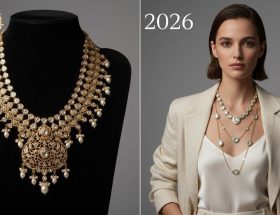

Layering necklaces has evolved from a runway styling trick into a core wardrobe skill. Done well, it adds depth, texture, and personality to everything from a plain white tee to an evening dress. Done poorly, it reads as clutter. The difference comes down to a handful of deliberate decisions: length, proportion, weight, and color. This guide breaks down the mechanics of a polished layered look so you can build combinations that feel intentional every time.
Start With a Foundation Chain
Every successful layering stack begins with a base. Think of your shortest chain as the anchor point that establishes the rhythm for everything above and below it. A delicate choker or a fine 16-inch chain sits close to the collarbone and frames the neckline without competing for attention.
Choose a foundation piece that works with your most-worn necklines. A crew neck calls for a slightly longer base, while a V-neck or scoop neck pairs naturally with a shorter choker. The foundation should be the most understated piece in the stack—it is the scaffolding, not the statement.
Recommended Base Lengths
- 14–16 inches: Choker and collarbone length; ideal as a subtle anchor
- 18 inches: The classic princess length; sits just below the collarbone
- 20–24 inches: Matinee length; works as a mid-layer or a solo statement
Build With Deliberate Length Gaps
The single most common layering mistake is clustering chains too closely together. When two necklaces sit less than an inch apart, they tangle, overlap awkwardly, and visually cancel each other out. Aim for a gap of roughly one to two inches between each layer so every chain has room to breathe.
A reliable formula is to work in increments: a 16-inch base, an 18-inch middle layer, and a 20- to 22-inch pendant or lariat as the finisher. This graduated approach creates a clean, cascading line down the chest that flatters nearly every body type and outfit.
Layer Spacing at a Glance
| Foundation | 14–16 inches | Anchors the look; understated and fine |
| Middle | 18–20 inches | Adds texture or a small charm |
| Finisher | 22–24+ inches | Draws the eye; pendant or statement piece |
Mix Weights, Textures, and Metals
Visual interest comes from contrast, not repetition. Pairing a whisper-thin cable chain with a chunkier curb chain creates dimension that a stack of identical chains can never achieve. The same principle applies to texture: combine smooth, polished links with hammered, beaded, or twisted designs.
On the metal question, the old rule of matching everything is long gone. Mixing gold and silver is now a hallmark of confident styling. The key is intentionality—either distribute the metals evenly across the stack or make one metal dominant and let the other appear as an accent. A two-tone piece in the middle layer can act as a bridge that ties the palette together.
Contrast Pairings That Work
- Fine + chunky: A delicate chain beside a bold curb or rope chain
- Polished + textured: Smooth links against hammered or beaded metal
- Warm + cool: Gold and silver balanced evenly or with one dominant tone
- Plain + embellished: A bare chain layered with a charm or pendant piece
Balance Pendants and Charms
Pendants are powerful focal points, and too many of them turn a stack into noise. The safest approach is to feature a single pendant, placed on the longest layer where it has room to hang freely. Smaller charms can appear on middle layers, but keep them modest in scale and spaced apart from the main pendant.
Pay attention to shape as well as size. A round pendant pairs well with a geometric charm; two large circular pendants on adjacent layers will fight for the same visual space. If you want to stack multiple pendants, stagger them across different lengths so each one occupies its own zone.
Adapt the Stack to the Neckline and Occasion
Layering is not a fixed formula—it should respond to what you are wearing. A high neckline benefits from longer layers that create a vertical line, while a deep V-neck can carry a shorter, denser stack. Strapless and off-the-shoulder silhouettes leave the entire collarbone open, making them ideal for a dramatic three- or four-layer arrangement.
For everyday wear, two or three delicate layers in a single metal tone deliver polish without fuss. For evening, increase the weight and add a stone-set or sculptural finisher. At the office, keep the stack tight and the chains fine so nothing jangles or distracts.
Practical Tips for a Tangle-Free Result
Final Thoughts
Great necklace layering is a study in controlled contrast. Anchor with a fine foundation, space your lengths with purpose, mix weights and metals with intention, and let a single pendant carry the focal point. Master those four decisions and the rest becomes personal expression. Start with two layers, refine the spacing, and build from there—your stack should look considered, never crowded.